
Healthcare Growth & Budgeting Guide | India | 2026
Healthcare Digital Marketing Cost in India: What Should Doctors & Hospitals Actually Budget?
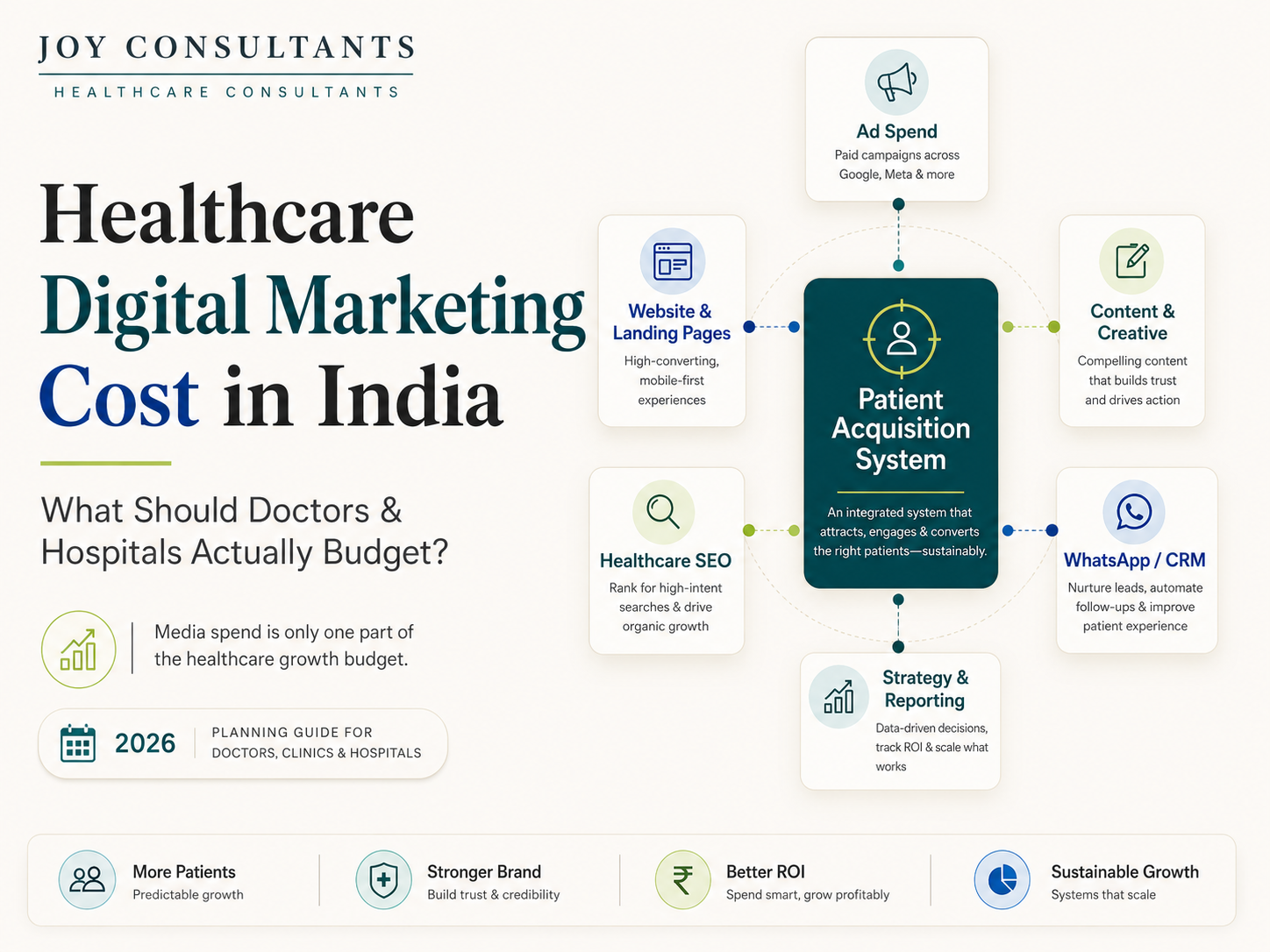
Healthcare digital marketing cost in India can vary widely between an individual doctor, a specialty clinic, a hospital and an international patient program. The right starting budget depends on specialty, city, competition, growth target, current digital assets and how effectively enquiries are converted into appointments.
The more useful question is not, “Which package should I buy?” It is: what is the smallest focused acquisition system that can address the current growth bottleneck, produce measurable learning and then scale responsibly?
Important: These are broad planning illustrations, not Joy Consultants quotations, market averages or guaranteed-spend recommendations. A sensible budget should be built around one clear acquisition objective and scaled from evidence.
specialists, surgeons and clinics seeking more consistent patient enquiries.
start with one geography, a few priority services and the channels closest to patient intent.
Healthcare digital marketing is not one expense
A common budgeting mistake is to treat digital marketing as a single line item: "agency fee." In reality, a healthcare growth system usually contains several different cost centres.
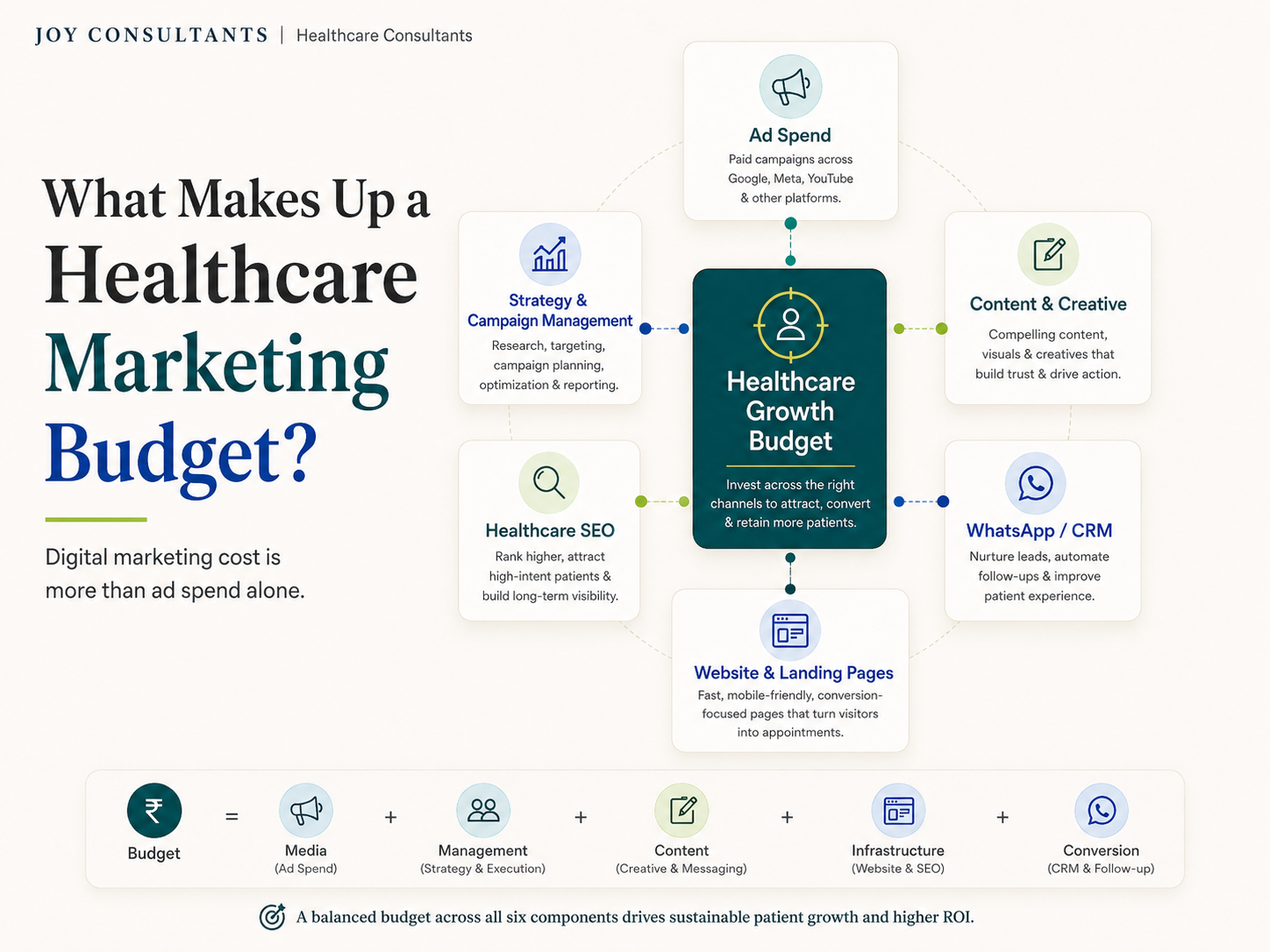
1. Strategy & campaign management
Specialty research, patient-intent mapping, channel planning, campaign setup, optimization, reporting and growth reviews.
2. Advertising media
Actual spend paid to platforms such as Google or Meta. This should normally be shown separately from the agency's professional fee.
3. Website & landing pages
Service pages, campaign landing pages, mobile optimization, lead forms, call/WhatsApp paths, conversion improvements and technical fixes.
4. Healthcare content & creative
Doctor-led videos, procedure explainers, social creatives, ad variants, patient education assets and specialty-specific copy.
5. SEO & local visibility
Technical SEO, treatment/service pages, local search, content architecture, internal linking and long-term organic discovery.
6. Enquiry conversion systems
WhatsApp flows, CRM stages, response scripts, follow-up logic, appointment coordination, tracking and lead-quality feedback.
That distinction matters. A proposal that says "₹80,000 per month digital marketing" can mean very different things depending on whether ad spend, videos, website work, landing pages, CRM, SEO and creative production are included or billed separately.
Illustrative healthcare digital marketing budget bands in India
The table below is best used for planning conversations. It is not a published industry tariff and should not be read as a price quote from Joy Consultants.
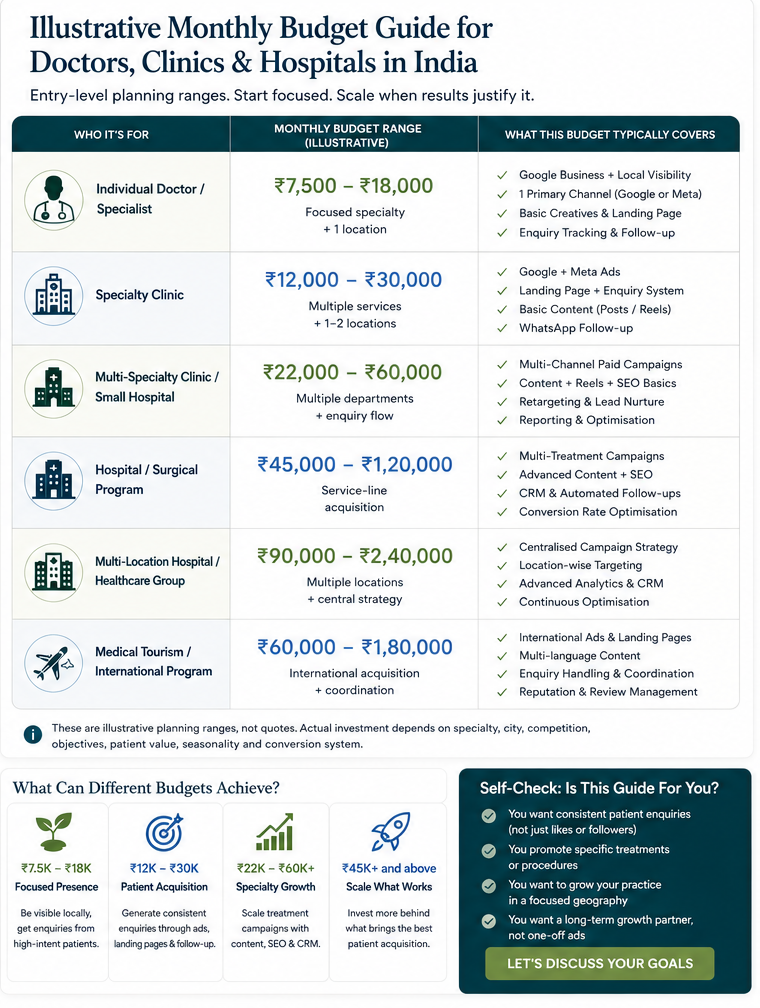
| Healthcare business | Illustrative focused monthly service investment* | Typical priority | What usually drives cost |
|---|---|---|---|
| Individual doctor / specialist | ₹7,500-₹18,000 | Focused local visibility + patient enquiries | One geography, priority services, search demand, basic content and follow-up |
| Single-location specialty clinic | ₹12,000-₹30,000 | Consultation + selected procedure pipeline | Multiple services, paid media, landing pages, creative and follow-up |
| Multi-specialty clinic / small hospital | ₹22,500-₹60,000 | Priority-department patient acquisition | Number of services promoted, media mix, content volume and reporting depth |
| Hospital / high-growth surgical program | ₹45,000-₹1.2 lakh+ | Selected OPD + procedure campaigns | Service-line campaigns, competitive search, content and conversion operations |
| Multi-location hospital / healthcare group | ₹90,000-₹2.4 lakh+ | Location + specialty portfolio growth | Scale, governance, media budgets, creative operations and analytics |
| Medical tourism / international patient program | ₹60,000-₹1.8 lakh+ | Focused source-market enquiries + coordination | Countries, languages, treatment category, media costs, trust assets and follow-up cycles |
*Important: These lower public-facing bands represent focused professional service / execution starting points and exclude Google/Meta media spend, major website rebuilds, large video-production days and third-party software unless specifically included in scope. Media should be budgeted separately according to patient-acquisition targets.
A practice should not choose a budget merely because it falls inside one of these bands. Two orthopedic surgeons in the same city can require completely different investments if one wants 20 additional consultations per month and the other wants to build a robotic joint replacement program across multiple cities.
A better way to calculate your healthcare marketing budget
Start from the patient outcome you want, then work backwards through the funnel.
Target attended consultations ÷ lead-to-attendance rate = qualified enquiries required
Qualified enquiries required × expected cost per qualified enquiry = estimated media requirement
Media requirement + strategy + creative + landing page/CRM + SEO = working growth budget
Example: a specialist wants 20 additional attended consultations
Assume, purely for illustration, that 25% of qualified enquiries eventually attend an appointment. The practice would need roughly 80 qualified enquiries to produce 20 attended consultations.
If a working campaign assumption were ₹600 per qualified enquiry, the media model would be approximately ₹48,000. The practice could then decide whether that acquisition target is commercially sensible and what strategy, landing-page, content or follow-up support is actually necessary.
The principle is more important than the example: build the budget backwards from the desired patient outcome instead of purchasing a long service list first.
What should an individual doctor budget?
For an individual doctor, the first objective should usually be to build a concentrated system around one city, one clear specialty positioning and a small number of commercially important consultation or treatment pathways.
Priority 1: be discoverable when patients are actively searching
This may include Google Search campaigns, local search visibility and treatment/service pages. A doctor should not spread a small budget across every platform simply to appear active.
Priority 2: make the doctor's expertise understandable
Patients rarely evaluate a specialist from one advertisement alone. They may review the doctor's website, Google presence, social media, credentials, videos, hospital affiliation and patient communication before deciding to enquire.
Priority 3: fix the enquiry-to-appointment gap
If calls are missed, WhatsApp responses are slow or the receptionist cannot identify high-intent enquiries, increasing ad spend can simply increase leakage.
For this reason, an individual doctor's budget may be better concentrated on digital marketing for doctors, a strong conversion page, high-intent search acquisition and a basic follow-up system rather than a large volume of generic social media posts.
What can different doctor marketing budgets focus on?
These are planning levels, not fixed Joy Consultants packages. The purpose is to show how a doctor can begin with a narrow scope and expand only when the data supports it.
Typical focus: one geography, one or two priority services, essential local/search visibility, limited acquisition activity and basic enquiry tracking.
Typical focus: a clearer paid-acquisition system, campaign landing page, sharper creative, conversion tracking and WhatsApp/front-desk follow-up.
Typical focus: multiple treatment pathways, stronger doctor-authority content, SEO, retargeting, additional landing pages and deeper conversion reporting.
Scope note: These starter levels assume a narrow service scope and exclude paid-media spend unless specifically stated. Video production, major website work and software may also be separate. They are strategic illustrations, not bundled Joy Consultants packages.
Do not buy every digital service at once
A doctor does not automatically need Google Ads, Meta Ads, SEO, twenty reels, a website rebuild and a CRM implementation in month one. If the current bottleneck is local patient discovery, solve that first. If leads are already coming but appointments are weak, fix the conversion system before buying more traffic.
What should a specialty clinic budget?
A specialty clinic usually has more complexity than a single-doctor practice: several services, multiple patient segments, more staff and more opportunities for lead leakage.
A sound monthly budget may need to support:
- Google Ads for high-intent consultations or procedures
- Meta campaigns for awareness, education and retargeting where appropriate
- specialty/service landing pages
- doctor-led content and procedure explainers
- local SEO and Google visibility
- WhatsApp or CRM follow-up
- lead-quality and appointment reporting
The budget should also reflect the clinic's treatment mix. A dermatology consultation funnel, an IVF evaluation funnel and a spine-surgery second-opinion funnel have different decision cycles, patient concerns and conversion economics.
How hospitals should budget: by service line, not one marketing pool
Hospitals often make one of two mistakes: either they allocate one digital budget to every department, or they divide spend equally across specialties.
A better approach is to build service-line budgets around commercial and clinical priorities. For example:
- OPD growth for cardiology, orthopedics or gastroenterology
- high-value surgical programs
- diagnostics or preventive health programs
- new doctor or department launches
- city or catchment-area expansion
- international patient programs
Each service line can then have its own target, media allocation, landing page, creative strategy, lead-quality definition and conversion reporting. This is the logic behind a structured hospital patient acquisition system rather than one undifferentiated campaign.
Why high-value procedure campaigns usually need a different budget
High-value procedures often have a longer decision journey. A patient considering bariatric surgery, joint replacement, spine surgery, cardiac surgery, IVF or another major intervention may need multiple information and trust touchpoints before consultation.
The budget therefore cannot be assessed only from the cost of generating a form fill. It may need to support:
- high-intent Google Search campaigns
- procedure-specific landing pages
- doctor authority content
- patient education and objection handling
- consultation or second-opinion pathways
- remarketing within applicable platform rules
- structured counsellor or coordinator follow-up
- conversion tracking beyond the initial enquiry
A campaign can show an attractive CPL while producing poor commercial outcomes if it attracts low-intent enquiries. For a surgical practice, cost per qualified lead, consultation attendance and movement toward clinical evaluation are usually more meaningful operational measures.
What changes in a medical tourism marketing budget?
International patient acquisition adds complexity that domestic lead generation does not have. A hospital or specialist may need country-specific campaigns, multilingual communication, international patient coordinators, travel-related information, remote report review processes and longer follow-up cycles.
A serious medical tourism marketing program may therefore include:
- country and city prioritization
- treatment-specific international landing pages
- Google and Meta media by geography
- doctor/hospital trust assets
- WhatsApp-based international enquiry coordination
- remote consultation or evaluation workflows where clinically and operationally appropriate
- language adaptation
- lead-source and case-stage tracking
International campaigns should not be budgeted by simply converting an Indian domestic ad budget into another currency. The patient journey, competition, media economics and coordination load are different.
Seven healthcare marketing costs that are often missing from the initial proposal
1. Landing-page development
Sending paid traffic to a generic homepage can weaken campaign relevance and conversion. Procedure or service campaigns often require dedicated pages.
2. Tracking and analytics
Call clicks, WhatsApp clicks, form submissions, appointment stages and lead-source data need to be captured if marketing is expected to become measurable.
3. Creative refresh
Campaigns need new angles, formats and messages. Reusing the same creative indefinitely can reduce learning and performance.
4. Doctor video production
For many specialties, credible doctor-led communication is more useful than generic stock content. Shooting, scripting and editing should be budgeted deliberately.
5. CRM or WhatsApp workflow
A lead is not an appointment. The system between enquiry and consultation may require software, scripts, ownership, reminders and reporting.
6. SEO content and service-page expansion
Organic visibility is built through technical improvements, local search, authoritative service pages and useful content architecture. It should not be treated as a one-time keyword exercise. See our approach to healthcare SEO and patient discovery.
7. Internal team time
Doctors, coordinators, reception teams and hospital managers all influence marketing outcomes. Approvals, video shoots, lead feedback and appointment data require internal participation.
How should the budget be divided between Google Ads, Meta Ads, SEO and content?
There is no universal split. The allocation should follow patient intent.
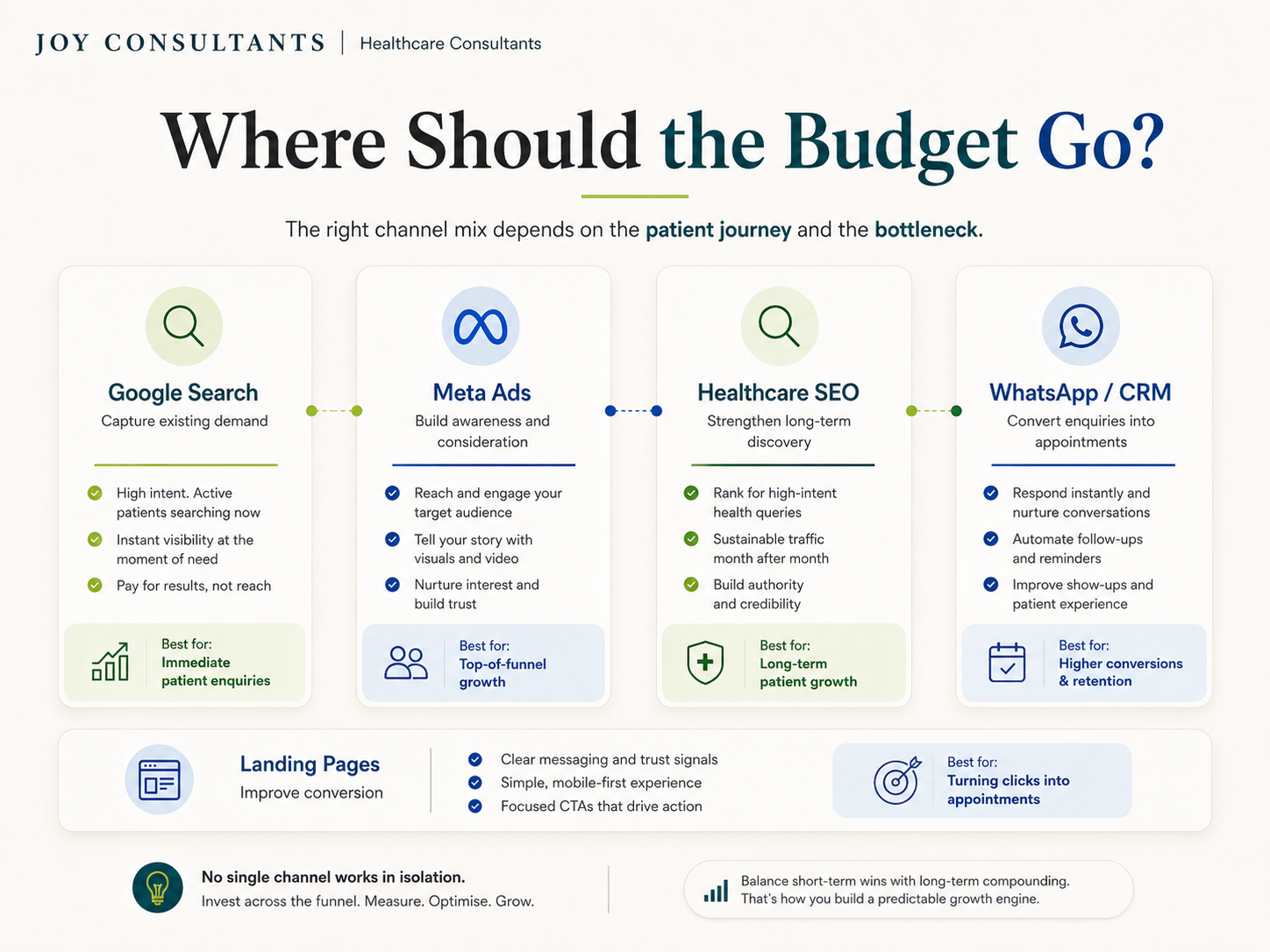
| Channel | Best strategic role | When it deserves more budget |
|---|---|---|
| Google Search | Capture active demand | Patients already search the condition, treatment, doctor or hospital |
| Meta | Create awareness, education and consideration | The service needs explanation or audience development, subject to platform policy |
| SEO | Build durable discovery and authority | The practice has long-term service/location search opportunities |
| Doctor-led content | Build trust and differentiation | The doctor's expertise influences patient choice |
| Landing pages / CRO | Convert existing traffic better | Traffic exists but enquiry quality or conversion is weak |
| CRM / WhatsApp | Reduce lead leakage | Enquiries are high but appointment movement is poor |
For a new practice with no website authority, a heavier initial investment in conversion assets may be necessary. A mature hospital with strong organic visibility may be able to allocate more aggressively toward service-line media and conversion optimization.
The KPI problem: cheap leads can create expensive growth
A healthcare marketing dashboard should move beyond impressions, clicks and raw CPL.
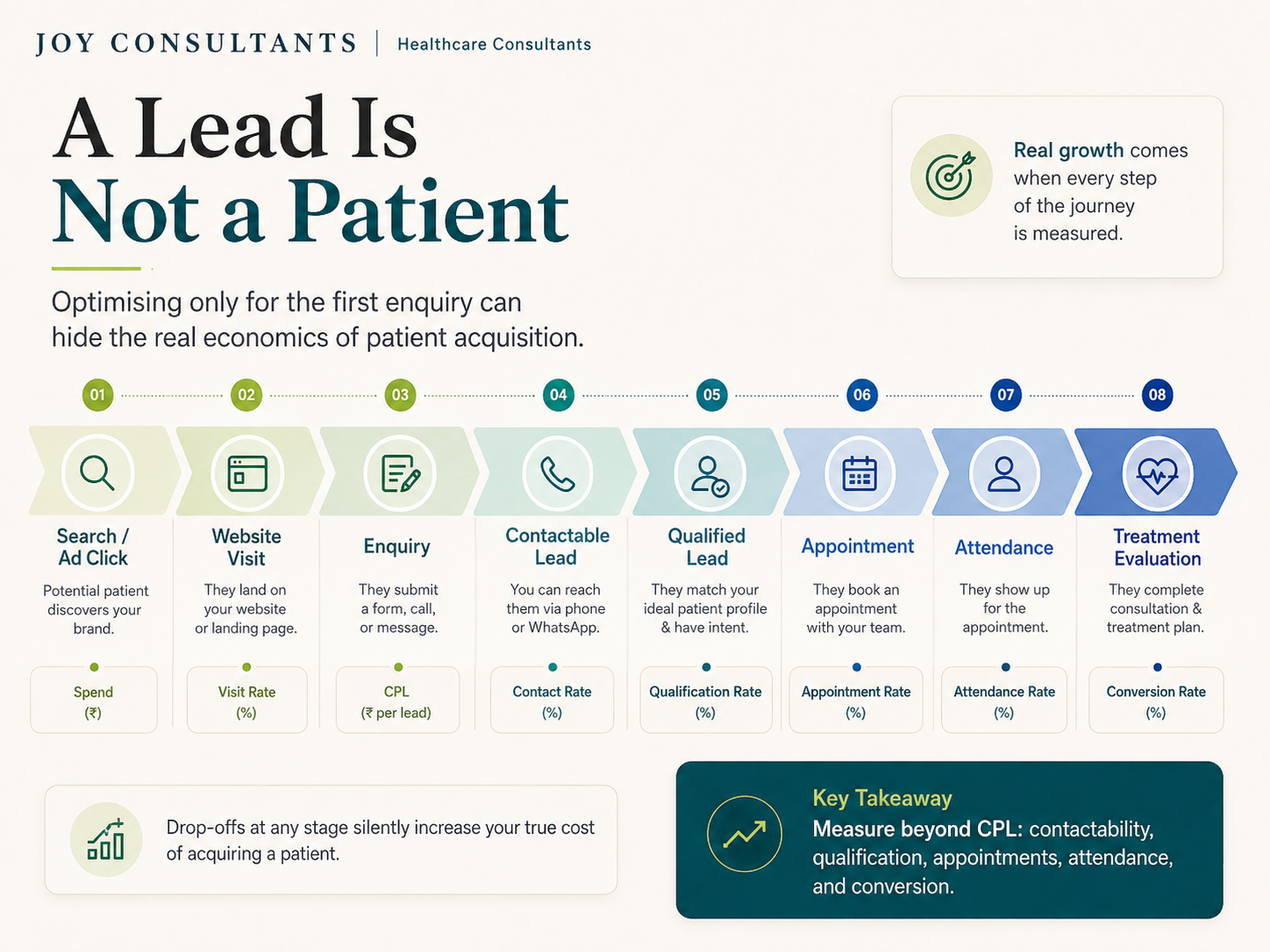
Useful operational metrics can include:
- cost per contactable lead
- cost per qualified lead
- lead-to-appointment booking rate
- appointment attendance rate
- consultation-to-evaluation or procedure movement
- revenue or contribution by campaign, specialty and city where data is available
- lead response time
- follow-up completion rate
This is why an agency that promises a low CPL without defining lead quality may not actually be offering the lowest-cost growth strategy.
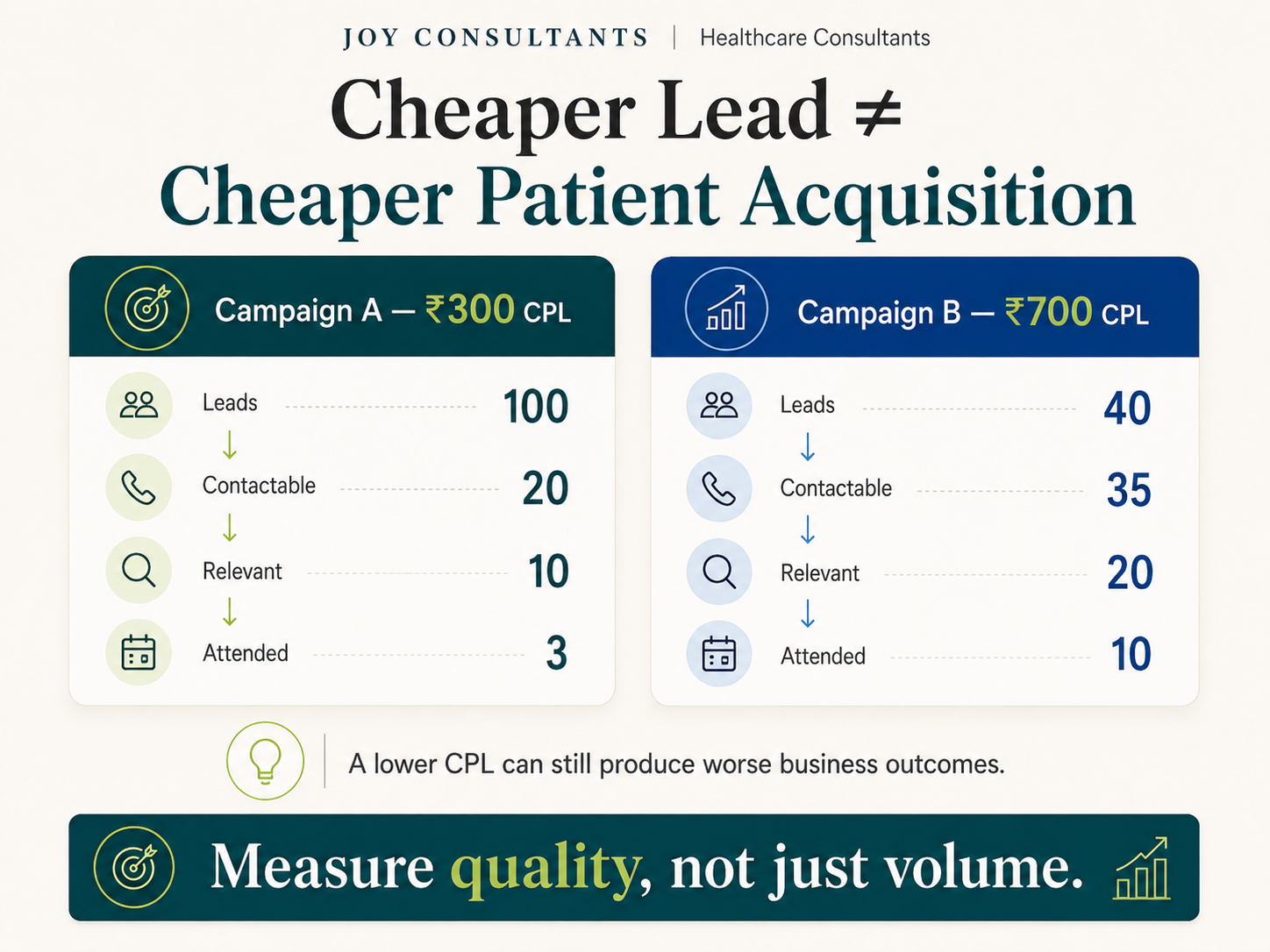
Should doctors spend more on ads or on the website?
If the website is slow, unclear, generic or difficult to contact from mobile, increasing traffic may amplify an existing conversion problem. If the website is strong but there is little traffic, the immediate priority may be demand capture.
In practice, the sequence often looks like this:
- clarify the specialty, service and growth objective;
- fix the minimum viable conversion infrastructure;
- launch measurable acquisition;
- improve creative and landing pages from real data;
- build SEO and authority for lower long-term dependency on paid media;
- strengthen enquiry-to-appointment conversion.
This is more efficient than buying every digital service at once.
How to evaluate a healthcare digital marketing agency quotation
Do not compare proposals only by monthly fee. Ask what each quotation actually contains.
- Is media spend included or separate?
- How many specialties, procedures, locations and campaigns are covered?
- Are landing pages included?
- Who writes and medically reviews patient-facing content?
- Are video shoots or edits included?
- Is SEO included, and what exactly is being delivered?
- Is WhatsApp/CRM setup included?
- How is a qualified lead defined?
- Will reporting stop at CPL, or track appointment movement?
- Who owns the ad accounts, analytics properties and website assets?
- How are healthcare advertising and communication restrictions handled?
A cheaper proposal can become expensive if the clinic later discovers that media spend, landing pages, creatives, tracking and CRM work were all excluded.
When should you increase the budget?
Scale should follow evidence, not excitement. Consider increasing spend when:
- lead quality is consistently acceptable;
- the team responds quickly;
- appointment capacity exists;
- landing pages convert adequately;
- high-performing keywords, geographies or creatives are identifiable;
- the economics remain commercially sensible after appointment and treatment-stage data are considered.
When should you reduce or reallocate the budget?
More spend is not always the answer. Reallocate first when:
- large numbers of leads are uncontactable;
- the front desk is missing calls or responding late;
- ads and landing pages promise different things;
- one specialty is consuming spend without producing meaningful consultations;
- campaigns are optimized for lead volume rather than lead quality;
- there is insufficient tracking to know what happens after the lead is generated.
So, where should your practice start?
There is no responsible universal answer such as "every doctor should spend ₹1 lakh." A smaller doctor practice can start with a focused acquisition objective, while a larger clinic or hospital can add channels and service lines as the economics become clearer.
For a doctor, that objective may be more relevant consultations. For a surgical practice, it may be more procedure-ready evaluations. For a hospital, it may be department-wise patient acquisition. For an international program, it may be more qualified enquiries from specific source markets.
The budget should then be divided between demand capture, trust building, conversion infrastructure and follow-up.
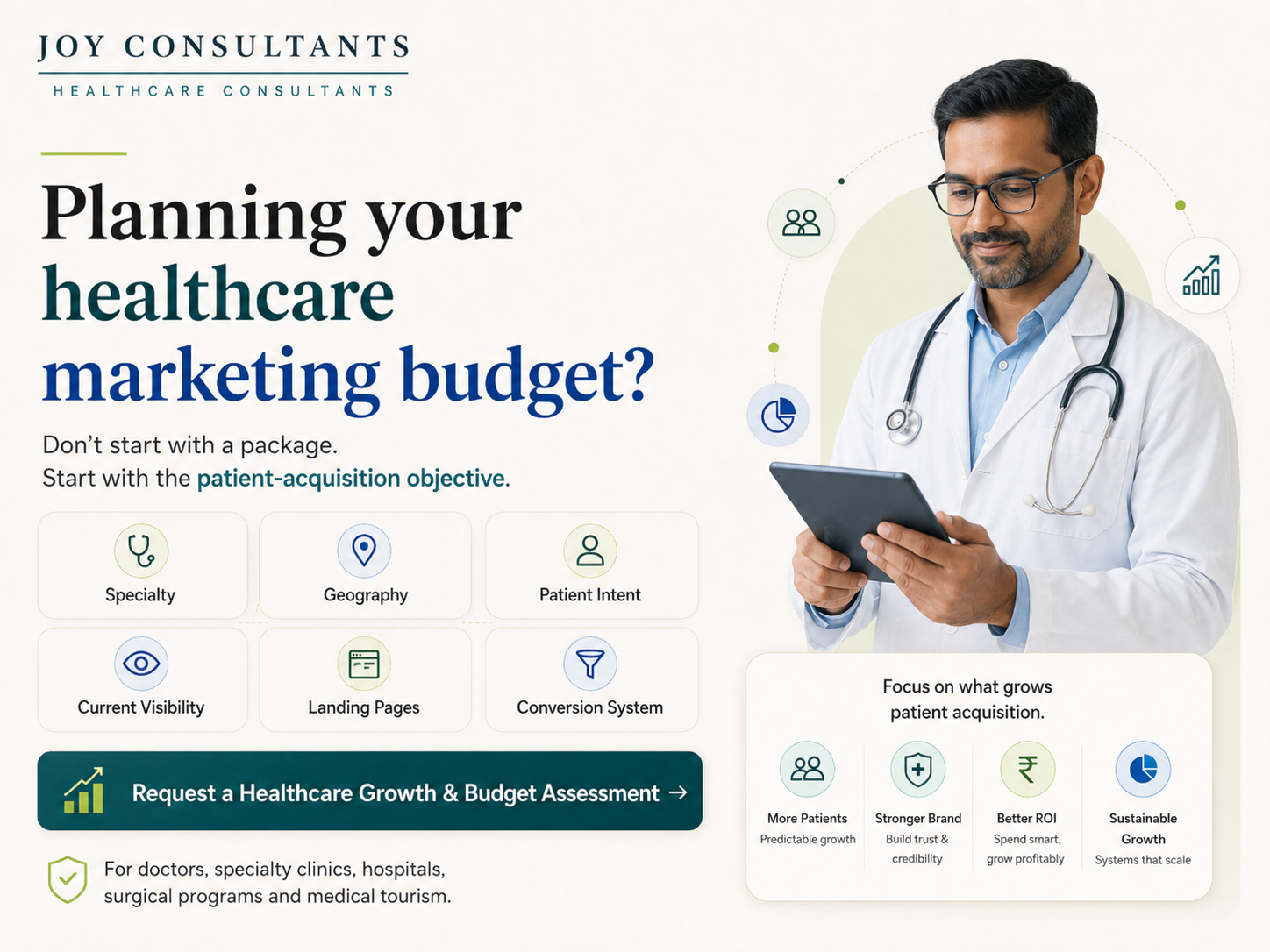
Get Your Doctor Growth Budget Map
Joy Consultants can review your specialty, city, priority treatments, current digital presence and enquiry flow, then identify the most sensible place to start before you commit budget across multiple channels.
Request Your Growth Budget MapFrequently asked questions
How much does digital marketing cost for a doctor in India?
There is no fixed standard cost. As an illustrative focused service range, an individual specialist may begin with roughly ₹7,500-₹18,000 per month, excluding paid-media spend, when the scope is deliberately focused around one geography, a few priority services and the most relevant acquisition channels. The right number should ultimately be built from the target number of qualified enquiries and appointments.
How much should a hospital spend on digital marketing?
Hospital budgets vary substantially because a hospital may market several specialties, procedures, locations and service lines at the same time. A hospital may begin by allocating budget to selected priority service lines rather than marketing every department at once. Larger multi-location or international programs will require higher budgets as media, content, locations and conversion operations expand. Service-line budgeting is generally more useful than assigning one equal amount to every department.
Is Google Ads spend included in a digital marketing agency fee?
Not necessarily. Agency professional fees and platform media spend are usually different cost items. Every proposal should state clearly whether Google Ads and Meta spend are included, excluded or billed separately.
What is a good starting Google Ads budget for a doctor?
The starting budget should depend on local search demand, specialty competition, target geography and the number of qualified enquiries required. Instead of choosing an arbitrary amount, estimate the required qualified leads and multiply them by a working cost-per-qualified-lead assumption, then test and refine from live performance.
Should a doctor invest in SEO or paid ads first?
Paid search can capture existing demand faster, while SEO builds longer-term discovery and authority. Many practices need both, but the order depends on how urgently patient acquisition is required, how strong the current website is and whether the practice already ranks for valuable local and treatment searches.
Why is cost per lead not enough to evaluate healthcare marketing?
Because every lead does not have the same value. Contactability, clinical relevance, appointment booking, attendance and eventual service or procedure movement matter. A low CPL can hide poor lead quality or weak conversion.
What should be included in a healthcare marketing retainer?
The scope may include strategy, campaign management, creative, content, SEO, landing pages, analytics, reporting and enquiry-conversion support. The exact deliverables should be stated explicitly. Media spend, production shoots, software and major website development may be separate depending on the engagement.
Can a small clinic start with a limited budget?
Yes, but the budget should be concentrated. A small clinic is usually better served by prioritizing one geography, a few high-intent services and a clear conversion path rather than dividing a small amount across Google, Meta, SEO, social media, video and multiple specialties simultaneously.